

Quick Answer
Animated video cost typically ranges from $1,000 to $50,000+ per finished minute, depending on animation style, video length, project complexity, and who produces it. Most businesses invest between $3,000 and $15,000 for a professionally produced 60-second 2D explainer video, while simple motion graphics projects can start below $1,500.
Animated Video Cost: Full Pricing Guide & Breakdown
If you’ve ever requested quotes from different animation studios, you’ve probably wondered why one company charges $2,000 while another quotes $20,000 for what seems like the same video. The reality is that no two animation projects are identical.
The global animation industry continues to grow as businesses increasingly rely on animated content for marketing, education, recruitment, SaaS onboarding, healthcare communication, and product demonstrations. According to research, the global animation market is expected to surpass $600 billion by the early 2030s, driven by rapid demand for digital advertising, streaming platforms, gaming, and branded video content.
Understanding what goes into animation pricing helps you invest wisely—not simply choose the cheapest quote.
Key Takeaways
- Animated video pricing varies dramatically because every project is custom-made, and production quality influences the final investment.
- A professional 60-second explainer video typically costs between $3,000 and $15,000, while premium productions with custom artwork and advanced animation can exceed $25,000.
- Motion graphics usually offer the most affordable professional option because they rely less on character animation and complex illustration.
- The largest portion of your budget goes toward animation production itself, where artists create illustrations, movements, transitions, and visual storytelling.
- Longer videos often reduce the cost per minute because planning, scripting, and design work are spread across more content.
- AI tools are making production faster, but successful animated videos still depend on experienced writers, designers, animators, and creative directors.
- Comparing quotes based only on price can be misleading—always evaluate what services, revisions, strategy, and deliverables are included.
How Much Does an Animated Video Cost?
The table below provides realistic 2026 pricing ranges based on current market averages. Actual costs vary depending on complexity, customization, revisions, and production team.
| Animation Style | Typical Cost Per Minute | Best For |
| Whiteboard Animation | $1,000–$5,000 | Training, education, simple explainers |
| Motion Graphics | $1,000–$7,500 | SaaS, finance, presentations, product marketing |
| 2D Character Animation | $3,000–$15,000 | Explainer videos, startups, storytelling |
| 3D Animation | $8,000–$50,000+ | Products, manufacturing, healthcare, architecture |
| Mixed Media Animation | $5,000–$20,000 | Commercial campaigns, brand films |
| DIY / AI Video Tools | Under $500/month | Internal content, quick drafts, social media |
Quick takeaway: Motion graphics generally deliver the best balance between quality and affordability, while fully custom 3D animation commands premium pricing due to its technical complexity.
Understanding Animation Video Costs: Why Pricing Varies Across Styles
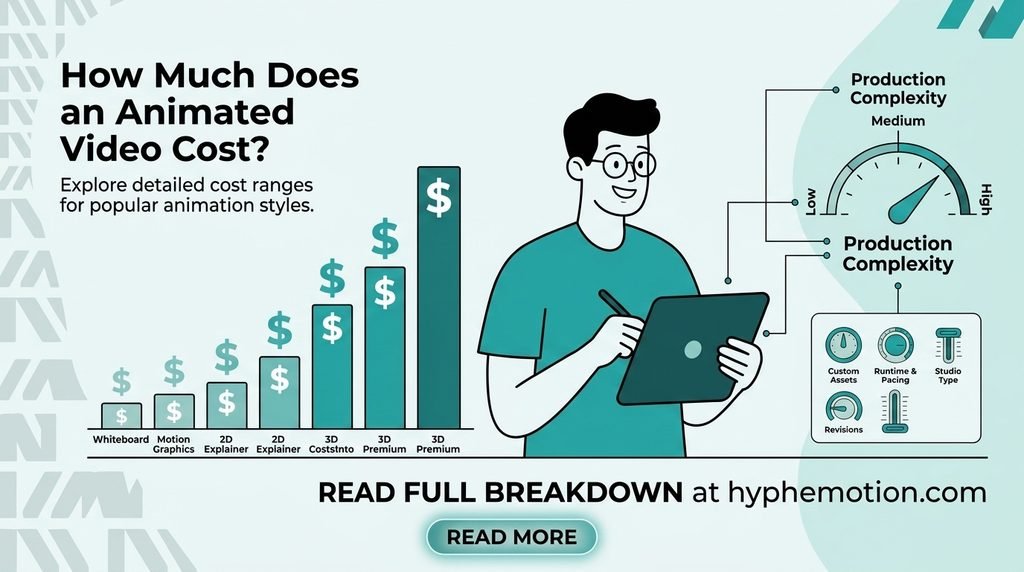
Not all animation styles require the same level of execution. A quick motion graphics video utilizing pre-existing brand assets involves a vastly different workflow than a custom, character-driven project built from scratch. When budgeting for professional animation, pricing is driven by three main variables: labor intensity, specialized artistry, and technical rendering requirements.
Here is how production investment scales across the primary animation styles:
Motion Graphics ($1,000 – $7,500+ / min):
The most cost-effective option for businesses. Because motion graphics focus on animating typography, logos, UI components, and vector graphics—rather than complex character rigs—production cycles are faster while still delivering high-impact visual clarity for SaaS demos and corporate presentations.
Whiteboard Animation ($1,000 – $5,000 / min):
Ideal for educational content and complex process breakdowns. While visually minimal, the cost is driven by continuous visual pacing, original illustration, and strong scriptwriting to keep audiences engaged.
2D Animation ($3,000 – $20,000+ / min):
The 2D animation industry benchmark for brand storytelling. Pricing hinges on whether you opt for vector-based character movement (3,000–5,000) or high-end, hand-drawn frame-by-frame character acting with creative strategy (10,000–20,000+).
Mixed Media ($5,000 – $30,000+ / project):
Blending live-action footage with animated overlays, titles, or 3D elements. Cost is dictated by live-production variables (crews, talent, shooting locations) alongside custom post-production VFX.
3D Animation ($8,000 – $50,000+ / min):
The most resource-intensive style. Unlike 2D, 3D requires building assets inside spatial software before animating, texturing, lighting, and rendering them. Entry-level budget covers simple product visualizations, while premium cinema-grade 3D requires custom character rigging, fluid simulations, and high-compute rendering pipelines.
What Drives Your Final Quote?
Beyond the baseline style, experienced animation studios calculate final project pricing using four core production factors:
- Complexity of Assets:
Custom-illustrated characters and photorealistic 3D models require significantly more artist hours than standardized icons or brand guidelines.
- Runtime & Pacing:
Longer videos require more rendered frames, but video density matters just as much—a fast-paced 30-second commercial with 15 scene changes can cost more than a slow-paced 2-minute explainer.
- Turnaround Time:
Standard production pipelines range from 4 to 8 weeks. Rush turnarounds require allocating dedicated multi-artist pods, which increases labor costs.
- Licensing & Extras:
Professional broadcast rights, custom music composition, multi-language voiceovers, and localization add to the baseline production cost.
What Drives Animation Video Cost Up or Down (Key Pricing Factors)

Understanding why one animated video costs $2,000 while another costs $25,000 helps you compare quotes more effectively. Animation isn’t priced solely by video length—it’s influenced by creative complexity, production requirements, turnaround time, and the people involved.
Let’s look at the biggest factors that affect your investment.
Project Complexity (Characters, Scenes, and Movement)
The more custom work your project requires, the higher the production cost. A simple explainer with animated icons is much quicker to produce than a story-driven video featuring multiple characters, detailed environments, and cinematic transitions.
Here are a few examples:
| Project Element | Typical Impact on Cost |
| Additional custom character | +10–20% |
| Complex character rigging | +15–30% |
| Animated backgrounds | +10–25% |
| Multiple scene changes | +10–20% |
| Frame-by-frame animation | +25–50% |
| Lip-sync animation | +10–15% |
Static vs. Animated Backgrounds
Static backgrounds are less expensive because they’re designed once and reused throughout the video. Fully animated environments require extra illustration, movement, and rendering time, increasing production hours.
Limited Animation vs. Full Animation
Many marketing videos use limited animation, where only selected elements move. Full animation, with expressive characters, fluid motion, and cinematic camera work, demands significantly more labor.
Video Length and Economies of Scale
Longer videos naturally cost more, but not always in direct proportion. Since planning, scripting, and creative direction are completed once, the cost per minute often decreases as the video length increases.
| Video Length | Typical Cost Range | Notes |
| 30 Seconds | $1,500–$7,500 | Great for ads and social media campaigns |
| 60 Seconds | $3,000–$15,000 | Most popular for explainers and product videos |
| 2 Minutes | $6,000–$25,000 | Better value per minute than shorter videos |
| 5+ Minutes | $12,000–$60,000+ | Often used for training, education, and onboarding |
Pro Tip: Instead of creating five separate 30-second videos, many businesses save money by producing one longer animation and repurposing it into shorter clips for different platforms.
Asset Creation and Custom Design
One of the biggest differences between a premium animation studio and a budget provider is how much artwork is created specifically for your brand.
Custom Assets
These include:
- Original character illustrations
- Brand-specific icons
- Bespoke backgrounds
- Product illustrations
- Infographics
- Animated UI demonstrations
Because they’re designed from scratch, custom assets require more creative time—but they also give your video a distinctive, memorable look.
Template-Based Assets
Template-driven videos reuse existing graphics and animation libraries. They’re quicker and less expensive but may feel generic or less aligned with your brand identity.
| Design Approach | Cost | Best For |
| Stock Assets | Lower | Internal videos, startups, limited budgets |
| Semi-Custom | Moderate | Marketing campaigns |
| Fully Custom Design | Higher | Brand storytelling, premium campaigns |
Audio, Voiceover, and Music
Professional audio is often underestimated, but it has a significant impact on how polished your final video feels.
Here’s a general breakdown:
| Service | Typical Cost |
| Professional Voiceover | $200–$1,000+ |
| Licensed Music | $50–$500 |
| Custom Music Composition | $500–$3,000+ |
| Sound Design & Effects | $300–$2,000 |
A professional voice actor improves pacing, credibility, and audience engagement. Likewise, carefully selected music and sound effects help reinforce emotion and brand identity.
Revisions, Rush Delivery, and Project Management
Most professional studios include one to three revision rounds in their pricing. Additional revisions or major creative changes after animation begins can increase costs.
Common additional fees include:
| Service | Typical Cost |
| Extra Revision Round | $250–$1,500 |
| Script Rewrite After Approval | Varies by scope |
| Rush Delivery | +20–50% |
| Weekend or Holiday Production | Premium rates may apply |
One of the easiest ways to stay within budget is to finalize the script and storyboard before production begins. Changes made after animation starts often require scenes to be recreated.
How AI Tools Are Changing Animation Video Pricing (2026 Update)

Artificial intelligence is reshaping the animation industry—but it hasn’t replaced professional creative teams.
AI-powered tools now help with tasks such as:
- Script brainstorming
- Storyboard generation
- Voice synthesis
- Asset organization
- Lip-sync automation
- Background removal
- Motion cleanup
These technologies reduce repetitive work, allowing studios to produce videos more efficiently.
As a result, a growing number of AI-assisted animation studios now offer projects in the $1,500–$3,000 per minute range for certain styles, particularly motion graphics and simpler explainers.
However, AI still struggles with areas that require strategic thinking and originality, including:
- Brand storytelling
- Creative direction
- Emotional character animation
- Visual consistency
- Marketing strategy
- Complex motion design
The most successful studios combine AI-assisted workflows with experienced designers, writers, animators, and creative directors to deliver faster production without sacrificing quality.
Where Your Budget Goes: Inside the Animation Process

Clients often ask what actually drives the line items on an animation invoice. Professional animation isn’t an automated process—it’s a multi-disciplinary pipeline managed by a specialized team of strategists, writers, visual artists, and sound engineers.
To give you complete transparency into where your investment goes, here is how a studio allocates time and resources across the production lifecycle:
| Production Phase | Budget Share | Key Deliverables & Focus |
| Creative Strategy & Scriptwriting | ~15% | • Discovery alignment, audience targeting, and core messaging • Scriptwriting optimized for word count (approx. 130–160 words per minute) • Call-to-action (CTA) framing |
| Storyboarding & Concept Art | ~20% | • Scene-by-scene visual blueprints and camera angles • Style frames establishing custom illustration styles, characters, and brand colors • Alignment phase to lock visuals before movement begins |
| Professional Audio Production | ~10% | • Voiceover casting, directing, and commercial usage licensing • Multilingual localization or specific accent sourcing (if needed) • Custom sound design, Foley effects, audio mixing, and track mastering |
| Animation & Post-Production | ~50% | • Asset rigging, frame-by-frame movement, graphics, and visual effects • Spatial modeling, lighting, physics simulation, and rendering (for 3D) • 2D/3D compositing and multi-pass rendering |
| QA, Revisions & Delivery | ~5% | • Planned review cycles and targeted polish • Technical platform optimization (e.g., 16:9 for YouTube, 9:16 for Social) • Final rendering and high-res asset delivery |
The Hidden ROI Driver: Pre-Production
While the actual animation phase consumes the largest share of labor and compute time, the pre-production stages (Strategy, Scripting, and Storyboarding) are where the real value is created. Locking in style frames and scene transitions early prevents costly, time-consuming re-renders during the heavy animation phase—keeping your timeline predictable and your final product aligned with business goals.
Pre-Production vs. Production vs. Post-Production Budget Split
A simple way to understand your animation investment is to divide it into three phases:
| Production Phase | Typical Budget Share | What It Covers |
| Pre-Production | 20–30% | Discovery, scripting, strategy, storyboarding, concept art |
| Production | 50–60% | Illustration, animation, character rigging, design, rendering |
| Post-Production | 20–30% | Voiceover, music, sound design, revisions, final exports |
Why production takes the biggest share: This is where skilled animators spend the majority of their time creating the movement, visuals, and storytelling that bring your message to life.
Video Editing Cost vs. Animation Cost — What’s the Difference?
Many businesses use the terms video editing and animation interchangeably, but they’re actually two very different services. Understanding the distinction helps you choose the right solution—and budget—for your project.
Animation involves creating visuals from scratch. Designers and animators build characters, illustrations, icons, graphics, or 3D models and bring them to life through motion.
Video editing, on the other hand, works with existing footage. Editors cut clips together, improve pacing, add transitions, color correction, music, captions, graphics, and effects to create a polished final video.
For example:
- If you’ve filmed interviews with your team and need them refined into a promotional video, you need video editing.
- If you want an explainer video that visually illustrates how your SaaS platform works, you need animation.
- If you’re combining live-action footage with animated graphics and text overlays, you’ll likely need both services.
Typical Video Editing Cost
Video editing prices vary based on project complexity, editor experience, turnaround time, and the amount of raw footage.
| Service | Typical Cost |
| Freelance Editor | $25–$100 per hour |
| Professional Editor | $75–$200 per hour |
| Agency or Studio | $100–$300+ per hour |
| Social Media Video | $150–$1,000 |
| Corporate Video | $500–$5,000+ |
| Commercial Editing | $2,000–$15,000+ |
Simple edits involving trimming footage, adding music, and basic transitions are relatively affordable. However, advanced editing that includes motion graphics, visual effects, color grading, multi-camera synchronization, subtitles, and sound mixing requires significantly more expertise and time.
Animation Cost vs. Video Editing Cost
| Feature | Animation | Video Editing |
| Typical Cost | $1,000–$50,000+ per minute | $25–$300+ per hour or $500–$5,000+ per project |
| Primary Work | Creating visuals from scratch | Enhancing existing footage |
| Best For | Explainers, product demos, brand storytelling | Interviews, events, testimonials, podcasts |
| Production Time | Several weeks to months | Hours to several weeks |
| Creative Process | Illustration, scripting, animation, sound | Editing, pacing, effects, color grading |
When Do You Need Editing, Animation, or Both?
Choose video editing only if you already have quality footage and simply need it polished.
Pick animation only if you’re explaining a product, simplifying complex ideas, or visualizing concepts that can’t easily be filmed.
Choose both when producing marketing campaigns, product launches, customer stories, or brand films where animated graphics enhance live-action footage.
For many modern businesses, combining the two creates the most engaging results.
Frequently Asked Questions
How much does a 1-minute animated video cost?
A professionally produced 1-minute animated video typically costs between $3,000 and $15,000, depending on the animation style, level of customization, scriptwriting, voiceover, and production quality. Simpler motion graphics may cost less than $3,000, while premium 3D animation or highly customized brand videos can exceed $25,000 for a single minute.
How much does a 30-second animated video cost?
A 30-second animated video generally costs between $1,500 and $7,500. Shorter videos still require planning, scripting, design, and production, so they don’t cost exactly half as much as a 60-second video. The final price depends on complexity, animation style, revisions, and turnaround time.
What is the cheapest type of animation?
Motion graphics and whiteboard animation are usually the most affordable professional animation styles. Since they rely less on character animation and complex illustrations, they require fewer production hours while still delivering engaging, professional content for marketing, education, and presentations.
Is 2D or 3D animation more expensive?
In most cases, 3D animation is more expensive than 2D animation because it involves additional processes such as modeling, rigging, texturing, lighting, simulation, and rendering. While 2D animation is often ideal for explainers and marketing videos, 3D is preferred for product visualization, architecture, engineering, and medical demonstrations.
How much does professional voiceover cost for an animated video?
Professional voiceover typically costs between $200 and $1,000 or more, depending on the voice actor’s experience, language, recording quality, commercial licensing, and usage rights. International campaigns or multilingual projects may require multiple voice actors, increasing the overall production budget.
Should I hire a freelancer or an animation studio?
Freelancers are often a good choice for smaller projects with limited budgets, while animation studios are better suited for businesses that need strategy, creative direction, consistent quality, and a structured production process. Studios also provide dedicated project management and access to specialists across multiple creative disciplines.
How can I get an accurate animated video quote?
The best way to receive an accurate quote is to provide your goals, preferred animation style, estimated video length, target audience, timeline, and examples of videos you like. The more detailed your project brief, the easier it is for studios to prepare realistic pricing and production timelines.
How much does video editing cost compared to animation?
Video editing usually costs between $25 and $300 per hour or several hundred to several thousand dollars per project, depending on complexity. Animation generally costs more because visuals are created entirely from scratch rather than being assembled from existing footage. Projects that combine live-action and animation require both services.